
1,342 objections to nine flats on the old Bath Aqua Glass site beside The Bell. The council's noise officer has questions too; target decision date 23 October.
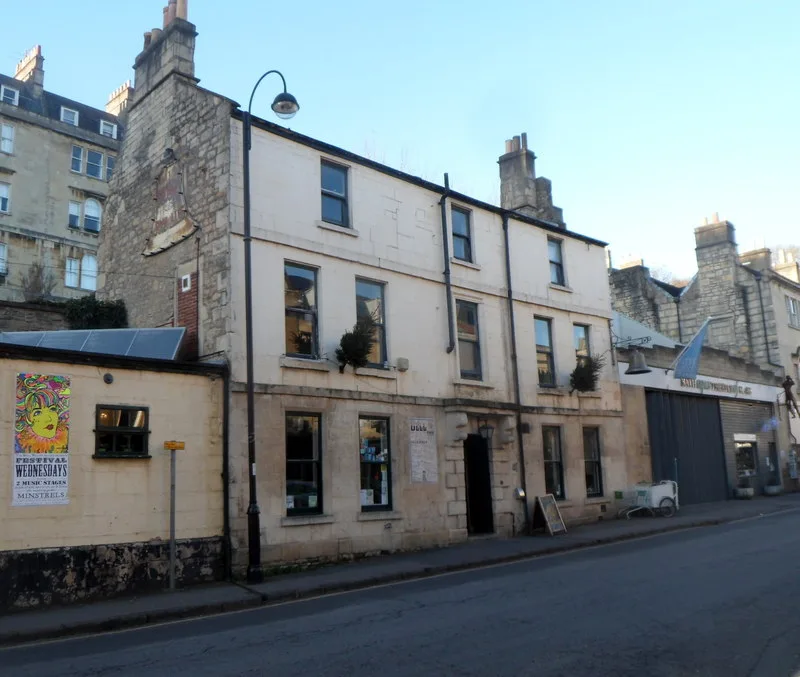
More than 1,300 people have objected to plans for nine flats on the old Bath Aqua Glass site in Walcot Street. The site is next door to The Bell, the community-owned pub and live music venue.
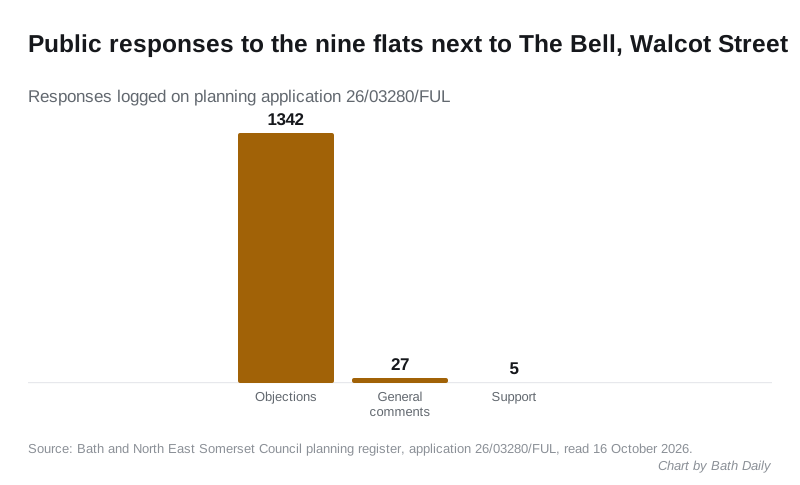
By Friday 16 October the council’s planning register had logged 1,374 responses. Of those, 1,342 were objections, 27 were general comments and five supported the scheme. The application is 26/03280/FUL, and it is still listed as pending consideration. The register gives a target decision date of 23 October.
Some reports have described the scheme as five flats. The application is for nine.
What is proposed
The applicant is Longacre Estates. Its planning, design and access statement says Bath Aqua Glass moved out of 105 to 107 Walcot Street in October 2025. The plan is to knock down the single-storey 1930s workshop and replace it with:
- a commercial unit on the ground floor
- seven one-bedroom flats and two two-bedroom flats on the floors above, including a penthouse in a mansard-style roof
- balconies and a terrace on the back of the building, which faces the Paragon
- 18 cycle spaces for residents and no car parking
The site is in the Bath conservation area and the World Heritage Site. The Bell next door is a Grade II listed building.
Why so many people object
Most objections are about noise, and what it could mean for The Bell. The pub has been owned by a co-operative of local members since 2013. Walcot ward councillor John Leach told planners it has upwards of 700 member-owners.
The fear is simple. If the flats are built, future residents could complain about music from next door, and those complaints could threaten the pub. Planning guidance calls this the agent of change principle: the new development, not the existing venue, has to deal with the noise.
The Bell’s board says the developer’s noise report is “fundamentally flawed”. In a letter on the register, its chair lists the problems. They include:
- the report describes The Bell as hosting “occasional live music”, when its own programme lists three to four performances a week
- it does not assess noise and vibration carried through the shared structure, such as bass
- the noise was measured from the front of the site, on Walcot Street, while the balconies face the back
- it relies on residents keeping their windows closed
The Music Venue Trust, a charity for grassroots venues, has objected on the same grounds. It says The Bell is one of only a few grassroots venues left on Bath’s part of the national touring circuit.
What the council’s own noise officer said
The council’s environmental protection team has not objected, but it has not signed the scheme off either. In a response dated 11 September, its officer asked the developer to answer several points first:
- why the beer garden was modelled, not measured, and whether the assumption of 70 people is too low, as objectors say
- whether the noise readings, taken from 13 to 18 May, covered any live music nights
- how readings at the front of the site captured music at the back
The officer also noted that The Bell’s premises licence, 16/02338/LAPRE, allows live music in its rear function room up to 15 times a year. They proposed a condition limiting low-frequency music noise inside the new homes, and asked how sound from the shop would be kept out of the flats above. The officer said they would comment further once those points were answered.
Heritage and design objections
Bath Preservation Trust objected on 12 October. It says the scheme squeezes four storeys between three-storey neighbours, and that council officers did not support it at the pre-application stage. It also says:
- the back of the building would be about 15 metres from homes on the Grade I listed Paragon
- some flats appear to fall below national space standards
- the west-facing flats would sit in the shadow of the Paragon for much of the year
Walcot councillor Oli Henman has objected too. He says the street, known as Bath’s artisan quarter, should keep the site for makers, light industry or cultural use.
Who decides
Updated 2 November: the register still showed the application as “Pending Consideration” on 2 November, with 1,342 objections, 27 comments and five in support. The national scheme of delegation took effect on 31 October, so a referral to committee now needs both the Head of Planning’s nominee and the Planning Committee chair to agree. How the new rules work.
Councillor Leach has asked for the application to go to the planning committee if officers are minded to approve it. In an email on the register he notes that new national planning rules take effect on 28 October, which change which applications councillors can call in. He has asked for this one to be treated as a committee case either way.
The council has not yet said publicly whether the application will go to committee. If officers refuse it, no committee is needed.
What it means for you
- You can read every document, including the noise report and The Bell’s letters, on the council’s planning record for 26/03280/FUL.
- If you want to comment, the planning record has a comment form. Comments are public and are published with your name.
- If the application goes to committee, the agenda will appear on the council’s meetings calendar about a week before the meeting. Anyone can attend, and residents can register to speak.
For more Bath planning cases, see our planning news page.
Have your say