
B&NES councillors can no longer call planning applications in to committee. Since 31 October two people decide which cases go, and most never will.
A ward councillor in Bath and North East Somerset can no longer send a planning application to the Planning Committee. Since 31 October, a national scheme decides which applications councillors may vote on, and most never will.
Under the new rules, only two people can send a case to committee: the council’s Head of Planning, as its “Nominated Officer”, and the chair of the Planning Committee, as its “Nominated Member”. Both must agree. If they disagree, officers decide the application (B&NES decision 2521, 30 October 2026).
The chair of the committee is Councillor Tim Ball, with Councillor Paul Crossley as vice-chair (B&NES Planning Committee).
Councillors did not vote on it
The changes to the council’s constitution went to full council on 17 September. Councillors were asked to approve them, but nobody moved a motion, so the item fell.
The council’s Interim Monitoring Officer then told the meeting she would make the changes herself, using a power in the constitution (rule 1.13). The minutes record both steps (Council minutes, 17 September 2026).
She signed the decision on 30 October, the day before the national rules took effect. The decision record says not making the changes “would leave the Council uncompliant with legislation” (B&NES decision 2521).
The officers’ report to council warned what happens if a committee decides a case the law reserves for officers: the decision “may be subject to judicial review by anyone aggrieved by the decision”, and could be quashed (council report, 17 September 2026).
What officers must now decide
The Town and Country Planning (Discharge of Local Planning Authority Functions) (England) Regulations 2026 list the “Schedule 1” cases that must go to officers. Councillors cannot take them, whatever the objections. They include:
- householder applications, such as extensions, loft conversions and garden buildings
- minor commercial development
- one to nine homes on a site smaller than half a hectare
- discharge of conditions and prior approvals
- reserved matters on outline permissions of fewer than 500 homes
- certificates of lawfulness and non-material changes
The only exception is an “own interest” application, made by the council, one of its councillors or officers, or where one of them has an interest. Those can still go to committee if the two nominated people agree (revised Planning Scheme of Delegation).
Everything bigger falls in “Schedule 2”. There is an “overriding presumption” that officers decide these too.
How a bigger scheme can still reach committee
B&NES has kept three local triggers, which it calls “triage filters”. Any one of them starts a “gateway test”, but none of them sends a case to committee by itself:
- a ward councillor asks, in writing to development_management@bathnes.gov.uk, before a decision and within two working days of the latest consultation closing
- the parish or town council objects or supports against the officer’s recommendation, giving planning reasons, before its consultation closes
- the Executive Director or Head of Planning thinks the committee should see it
At the gateway, the Nominated Officer and Nominated Member must both agree the case meets one of two legal tests:
| Test | What it covers |
|---|---|
| A | An economic, social or environmental issue “of significance to the local area” |
| B | A “significant planning matter” under the Local Plan and other material considerations |
B&NES has added its own reading of test A. It says this is “likely to include any application for new housing where there is a viability assessment in respect of affordable housing”. That is the case where a developer argues it cannot afford the full share of affordable homes.
The scheme also lists cases unlikely to pass test B. One is a scheme that complies with a detailed site allocation in the Local Plan. Another is where a statutory consultee’s concern, on flooding or highways for example, has been resolved by changes to the plans (revised Planning Scheme of Delegation).
Listed buildings keep more cases in play
This matters more in Bath than in most places. An application that would otherwise be Schedule 1 moves into Schedule 2 when the council considers it connected to a Schedule 2 application for listed building consent. In a city with so many listed buildings, more small applications stay eligible for the gateway test (revised Planning Scheme of Delegation).
How many cases went to committee this year
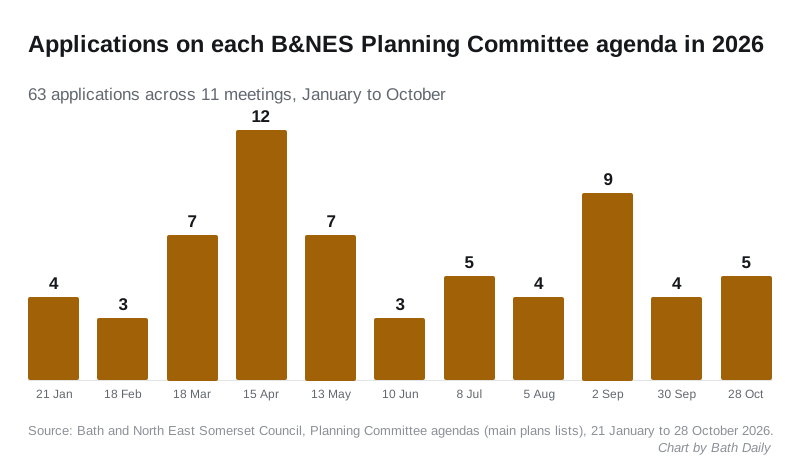
The Planning Committee met 11 times from January to October 2026. Its agendas listed 63 applications in total, from three in February and June to 12 in April (B&NES Planning Committee meetings).
Several were small. On 15 April the committee decided a change of use at 17 Foxcombe Road, Newbridge, from two flats back to one house. On 28 October it considered seven new homes at Lansdown View, Twerton (B&NES planning register, 25/04761/FUL; 26/00065/FUL). Housing schemes of that size, on sites under half a hectare, are now Schedule 1 cases, decided by officers.
What it means for you
- If you object to a neighbour’s extension, your objection still counts, and the case officer must weigh it. But the decision will be an officer’s, not a committee’s.
- Asking your councillor to “call it in” no longer guarantees a hearing. A councillor’s request now only starts the gateway test. Ask early: the deadline is two working days after the consultation closes.
- Your parish or town council’s view still matters, but only if it gives planning reasons and lands before its consultation closes.
- Watch for the referral record. The council must keep a record of every case the two nominated people considered, what they decided and why. It must report this to the Planning Committee regularly and publish it on its website (council report).
The Walcot Street flats
The new rules arrive with one of the most contested applications of the year still undecided. The plan for nine flats above a shop at 105-107 Walcot Street, on the old Bath Aqua Glass site, had 1,342 objections on the register on 2 November. It was still marked “Pending Consideration”, with its target decision date of 23 October passed (B&NES planning register, 26/03280/FUL).
Walcot ward councillor John Leach had asked for it to go to committee if officers were minded to approve it, as we reported in October. The council has not said how requests made before 31 October will be handled under the new scheme. We will report the outcome.
Sources
- B&NES decision 2521: Amendments to the Constitution, Planning terms of reference and delegation scheme changes, Monitoring Officer, 30 October 2026
- Revised Planning Scheme of Delegation and constitution changes, section 2.26
- Council report, 17 September 2026 and minutes of the meeting
- MHCLG statutory guidance on planning committees and the national scheme of delegation, 1 June 2026
- B&NES Planning Committee membership and 2026 meetings
- B&NES planning register entries 25/04761/FUL, 26/00065/FUL and 26/03280/FUL, read on 2 November 2026
Have your say