
Bath and North East Somerset Council has a £14.8 million gap to close for 2027/28. Its plan assumes a 4.99% council tax rise, with a consultation later this month.
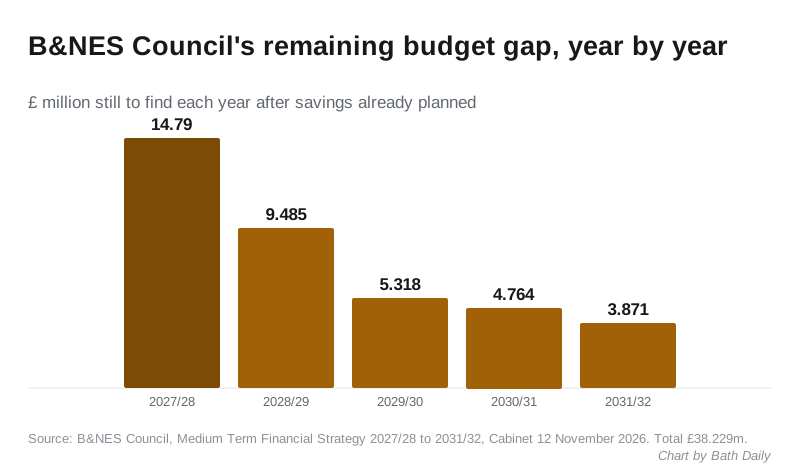
Bath and North East Somerset Council has to find £14.79 million to balance its budget for 2027/28. Its own plans so far cover about half of it.
The figure is in the council’s new Medium Term Financial Strategy, which goes to Cabinet on Thursday 12 November (report, full strategy). The council said residents will be consulted on its budget proposals later in November. The budget itself is set in February (B&NES Council, 4 November 2026).
The gap, year by year
The strategy forecasts a shortfall in every year to 2031/32. Over the five years the remaining gap adds up to £38.23 million.
| Year | Cost growth | Extra funding | Gap still to close |
|---|---|---|---|
| 2027/28 | £19.16m | £4.41m | £14.79m |
| 2028/29 | £13.67m | £4.44m | £9.49m |
| 2029/30 | £15.45m | £9.98m | £5.32m |
| 2030/31 | £15.47m | £10.55m | £4.76m |
| 2031/32 | £15.19m | £11.16m | £3.87m |
The gap for next year has grown since February, when the council put it at £12.59 million. The biggest single reason is £6.52 million of pressures from this year that the council now expects to carry on into next year.
How the council plans to close it
The council’s Transformation Plan, a separate Cabinet item, names £7.25 million of potential savings for 2027/28. It groups them under three headings: prevention, productivity and “place shaping” (Transformation Plan).
That leaves roughly £7.5 million still to find. Councillor Mark Elliott, Cabinet Member for Resources, said the plan “won’t solve the whole financial challenge and there will still be difficult choices ahead.”
The Transformation Plan puts the wider task bluntly. Over the next three years the council must find £28 million of savings, “equivalent to nearly 15% of our net revenue budget”. It adds that “many of the obvious solutions have already been implemented.”
What it assumes about council tax
The forecast assumes council tax rises by 4.99% in 2027/28 and every year after. That is 2.99% general council tax plus the 2% adult social care precept. The council assumes the government will again let it raise bills by that much without holding a referendum.
On this year’s figures, a 4.99% rise on the B&NES part of a band D bill (£1,914.03) would add about £95.51 a year. That is our calculation, not the council’s, and it leaves out the police, fire and parish parts of the bill. Our council tax bands page has every band for 2026/27.
The strategy also says B&NES has the second lowest council tax of the 12 unitary councils in the South West.
Why the money is short
The council gives three main reasons:
- Government funding. Its reform of how councils are funded cuts B&NES by £12.6 million by 2028/29, in the council’s figures.
- Children’s services. These are forecast to overspend by £7.39 million this year, mainly on high-cost care for the most vulnerable young people. The council looks after 242 children, including 33 unaccompanied asylum-seeking children.
- Adult social care. The strategy sets aside £18.53 million over five years for rising demand and care costs.
This year is already over budget
The same strategy shows the council heading for a £3.73 million overspend in 2026/27, on a net budget of £193.56 million. That is after it has used its whole £2.68 million contingency and drawn £2.66 million from a reserve held against lost commercial income.
Income is below target from commercial property, from heritage and from the council’s housing company. Visits to the Roman Baths, the council’s biggest earner, were 2% down in the first half of the year. The council blames fewer coach parties. The Baths took 971,000 visitors in 2025/26 and made a record £11.7 million surplus.
If the overspend cannot be closed, the council says it will dip into its budget contingency reserve. That reserve would then have to be topped up, which would add to the savings needed in later years.
Special needs: a deficit mostly written off
The strategy also covers the separate schools budget for children with special educational needs. It ran up a £46.5 million deficit by March 2026.
The Department for Education approved the council’s reform plan on 2 October. It will pay £41.94 million of that deficit, leaving the council to fund £4.57 million from 2028/29. The schools budget is forecast to overspend by a further £19.6 million this year.
What it means for you
- Nothing changes yet. Cabinet is asked only to approve the strategy. No service cut or charge is decided on 12 November.
- Have your say later this month. The council says the budget consultation opens in November. We will link to it when it is published.
- Expect a 4.99% rise in the B&NES part of your bill if the plan holds. The final figure is set at full council in February 2027.
- Watch the meeting. Cabinet meets at 6.30pm on 12 November and is streamed on the council’s YouTube channel.
Cabinet will also consider the council’s new public toilet strategy and a plan to buy back land for allotments at Combe Down at the same meeting.
Have your say