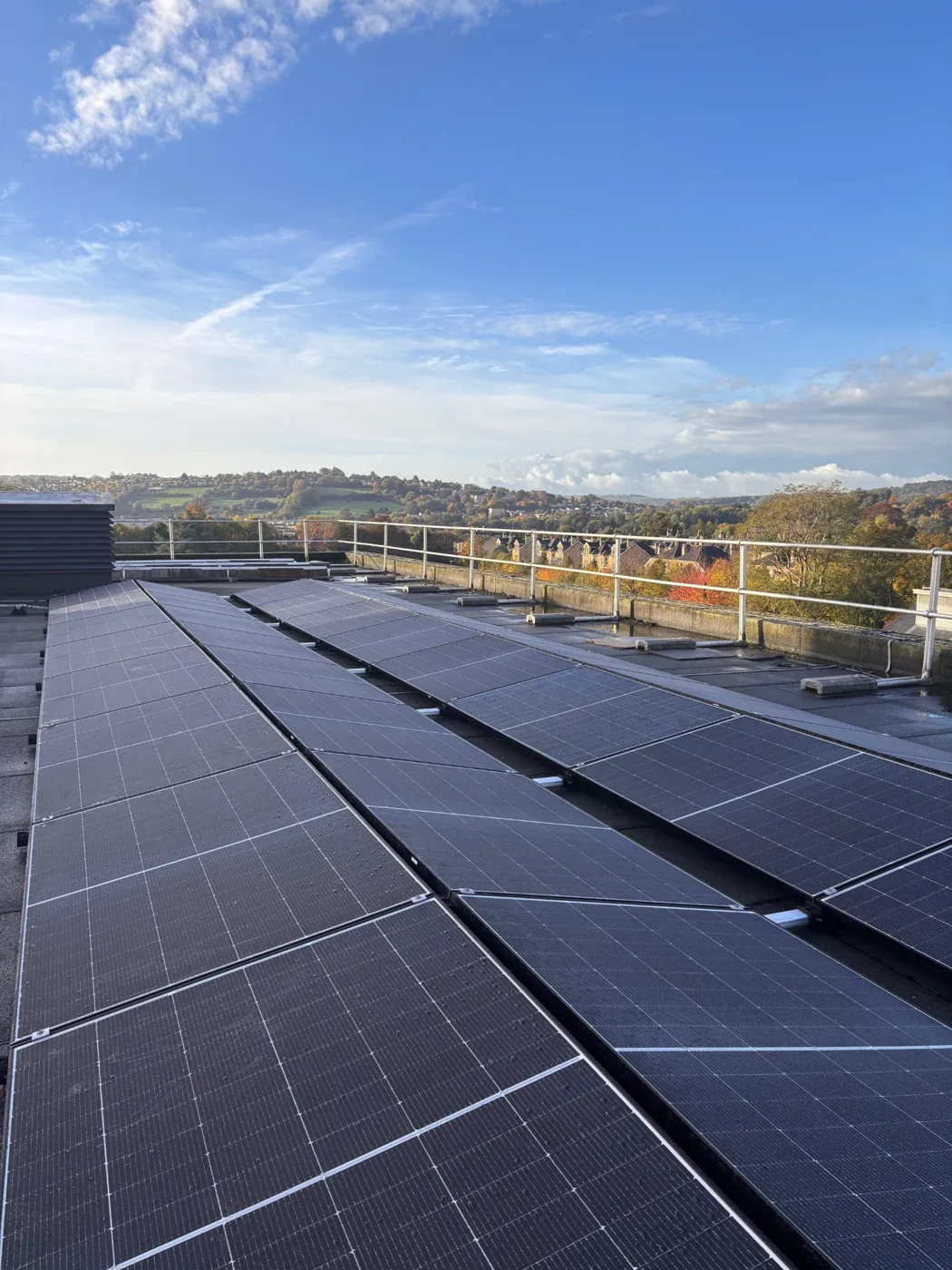

The Royal United Hospital in Bath has switched on 650 rooftop solar panels, saving 42 tonnes of carbon a year. Heat pumps on its roofs are due to follow.
The Royal United Hospital in Bath has switched on 650 new solar panels on its rooftops at Combe Park, the latest stage of a hospital-wide project to replace its ageing heating and cut its carbon emissions.
Overview
- What: 650 solar panels now working on the RUH’s roofs, part of Project Clean Heat.
- Carbon saved: 42 tonnes a year from the panels alone, about the yearly emissions of seven typical UK households, the trust says.
- Next: air-source and water-source heat pumps already installed on the hospital roofs are due to start working later this year.
- Whole project: 3,212 tonnes of carbon a year once complete later in 2026.
- Paid for by: a multimillion-pound grant from the Department for Energy Security and Net Zero, administered by Salix.
What else Project Clean Heat changes
The panels are one part of a wider programme that the trust describes as one of the largest environmental improvement schemes ever carried out on the hospital site.
Alongside them, the RUH has put air-source and water-source heat pumps on its rooftops, which it says are due to come into use later this year. The project also brings high-quality LED lighting, better insulation and more advanced heating controls, all meant to cut the energy the hospital uses.
When the whole project is finished, the trust says it will take 3,212 tonnes of carbon a year off the RUH’s emissions. It puts that as the equivalent of 14,500 return journeys between Bath and Edinburgh in an average petrol car, or the power for more than 1,000 UK homes for a year.
Why the hospital is doing it
Jon Lund, the RUH’s Site Finance Director and executive sponsor for the project, said: “At the RUH, one of our goals is to make Bath one of the healthiest places to live and work in the country. This means looking beyond the healthcare we provide and considering the wider factors that influence people’s wellbeing.”
He added: “Project Clean Heat will improve our facilities today, while also creating a greener hospital for future generations. Alongside reducing our environmental impact, the new heating systems, improved insulation and upgraded lighting will help to create a more comfortable environment for patients, visitors and staff.”
The trust points to the health effects of a changing climate: extreme temperatures, shifting weather and poorer air quality, which it says fall hardest on older people, young children and people with existing health conditions. The NHS has committed to becoming a net zero health service by 2045, and to reach net zero by 2040 for the emissions it controls directly.
Who is paying and who is doing the work
The work is funded by a multimillion-pound grant from the Department for Energy Security and Net Zero, administered by Salix. The RUH is delivering it with Veolia and the Carbon Energy Fund.
The project was shortlisted in the Net Zero Innovation category at the national IHEEM Healthcare Estates awards, which recognise healthcare estates work that cuts carbon and could be copied by other NHS organisations.
The hospital’s media release has the full details.
Last week the RUH opened a new jungle-themed waiting area in its children’s emergency department: that story is here.
Source: Royal United Hospitals Bath NHS Foundation Trust.
Have your say