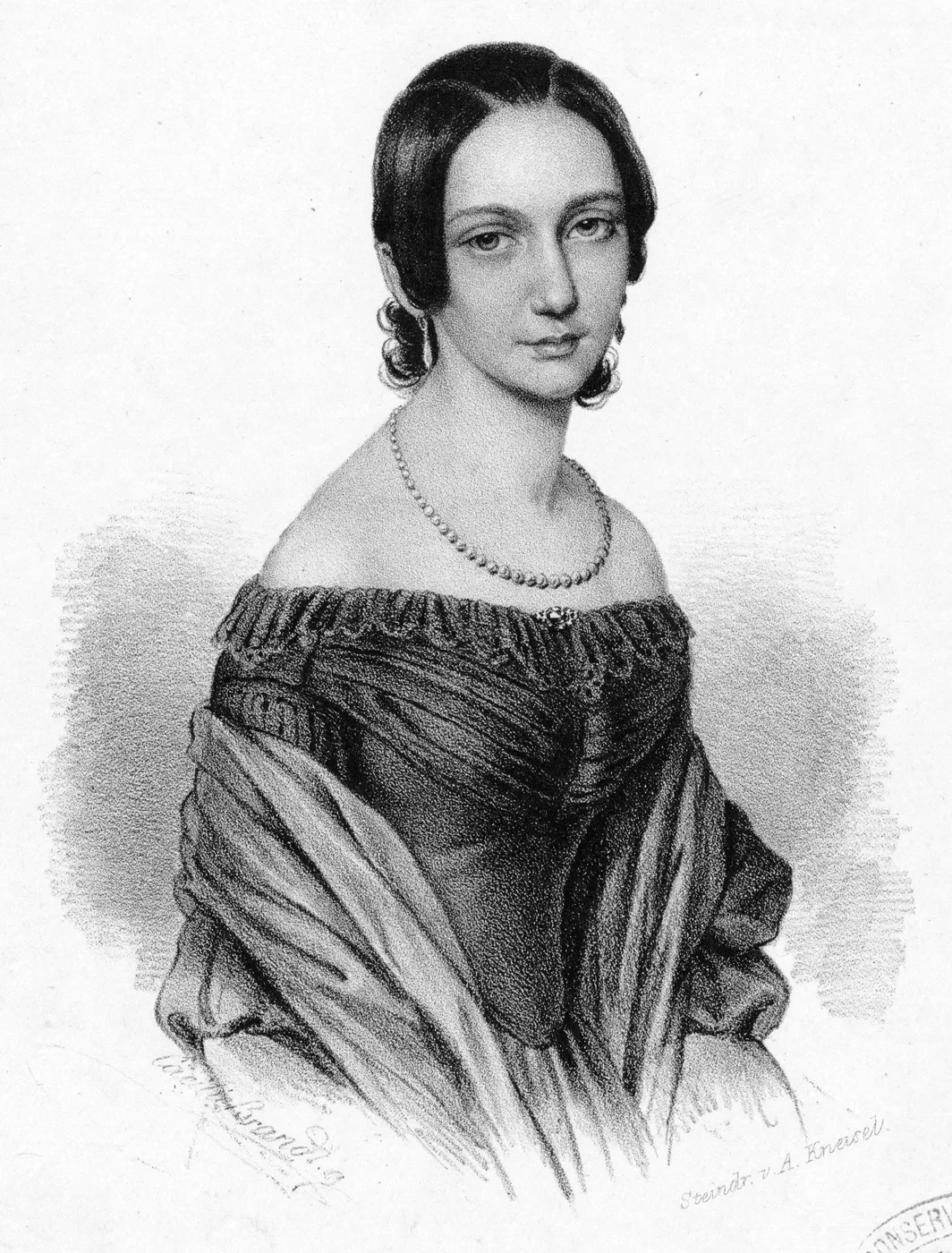

Clara Schumann was 36, with seven children and a career paying the bills, when Robert died. I, Clara tells her story at St Mary's Bathwick on 15 November.
When Robert Schumann died in 1856, Clara was 36, with seven surviving children and a career that helped pay the family’s bills. One of Europe’s leading pianists, she faced the task of sustaining that career through grief, family responsibilities and the physical demands of performance.
It is a different starting point from the description that still so often introduces her: the wife of a famous composer.
On Sunday 15 November, Dame Harriet Walter and pianist Lucy Parham bring her story to St Mary’s Bathwick in I, Clara, part of Bath Mozartfest. Combining narration and piano music, the performance offers a way into a life whose concerns extend well beyond the concert hall.
You need no musical training to appreciate the stakes. How do you protect time for your work when other people need you? What happens when your family depends on your earnings, and ill health makes earning uncertain?
A career from childhood
Born Clara Wieck in Leipzig in 1819, she was prepared for a musical career from childhood. Her father, Friedrich, a piano teacher, supervised an intensive education. She appeared at Leipzig’s Gewandhaus aged nine and was soon performing across Europe.
At 16, she played her own Piano Concerto in A minor with the Gewandhaus Orchestra, conducted by Felix Mendelssohn. Picture the scene: a teenage girl at the keyboard, presenting music she had written herself, with a leading orchestra accompanying her.
Composition was part of her early public identity. Her works include songs, piano pieces and a Piano Trio in G minor. They offer opportunities to encounter her imagination directly, beyond the role she occupies in someone else’s biography.
Marriage, children and touring
Her relationship with Robert developed against her father’s fierce opposition. They married in 1840, beginning a partnership of affection and artistic exchange, alongside difficult negotiations about domestic life. Both needed time and concentration for music. Finding that space within a growing household was another matter.
Clara bore eight children between 1841 and 1854. Seven were still alive when Robert died. Her performing career continued through marriage, motherhood and widowhood, providing income as well as artistic fulfilment.
Touring meant preparation, journeys and absences from home. Every appearance depended on practical arrangements as well as musical skill. The polished public performance was the visible part of a much larger working life.
Playing through pain
Then there was pain. Clara experienced chronic arm pain that could prevent her from playing and required periods of rest and treatment. For a musician whose livelihood depended on physical precision, this was a serious professional vulnerability.
Researchers Eckart Altenmüller and Reinhard Kopiez have examined her experience of chronic pain, describing how it disrupted her performing career. Their research reveals how physically demanding her livelihood could be.
Yet performing meant much more to Clara than earning money. It was central to her sense of herself: a vocation she wanted to pursue while she had the strength.
She also knew how to win over an audience. Clara adapted her concert programmes to the different musical tastes of Leipzig, Vienna and London. Understanding her listeners helped her introduce the music she wanted to champion.
The performer who shaped what we hear
This is why her achievements as a performer deserve recognition in their own right. Musical history often gives composers centre stage, but performers help decide which works reach audiences and survive. Clara’s importance lay partly in those choices, repeated across a lifetime of concerts.
She championed Robert’s compositions and helped shape his reputation after his death, performing his music and editing his works. The familiarity of his name today owes something to her sustained professional labour.
Recognising that contribution should also encourage curiosity about her own compositions. Listening allows us to encounter her as a creative artist, alongside the interpreter who brought other people’s music to life.
At Bath Mozartfest, narration will sit alongside music by Clara, Robert and other composers from their musical world. Together, words and piano offer an inviting introduction to her life.
Her success never resolved all its competing demands. Ambition, care, income and health continued to require negotiation. Understanding those conditions makes her achievements more remarkable, and gives us good reason to hear her afresh.

Going to I, Clara
- When: Sunday 15 November, 6pm to about 7.20pm
- Where: St Mary’s Church, Bathwick
- Who: Dame Harriet Walter (narrator) and Lucy Parham (piano)
- Tickets: £20, £32 or £42, plus a £1.50 processing fee per order, from the Bath Mozartfest website or the box office on 01225 463362 (event code MF6)
The festival’s page says the narrative is drawn from Clara’s letters and diaries, with music by Clara and Robert Schumann, Brahms, Liszt, Mendelssohn and Chopin. The rest of the festival programme is in our Bath Mozartfest 2026 guide.
Stacy Jarvis is a music historian, classical violinist and cultural journalist whose work has appeared in UK and international news outlets, including The Conversation, and specialist publications such as The Strad. Her portfolio is at sjarvis-violin.co.uk.
Have your say