
Ofsted and the CQC found inconsistent experiences for children with SEND in B&NES, and named CAMHS, neurodevelopmental and learning disability waits for action.
Ofsted and the Care Quality Commission have given Bath and North East Somerset the middle of three possible outcomes for its services for children with special educational needs and disabilities. Their verdict, published on 2 September, is that the local area partnership’s arrangements “lead to inconsistent experiences and outcomes for children and young people with SEND”. The partnership “must work jointly to make improvements” (Ofsted and CQC area SEND inspection report).
The inspection ran from 15 to 19 June 2026. It was the first full area SEND inspection here since March 2019. The next one is due within about three years, and the partnership has been told to update and publish its strategic plan against the report’s recommendations.
What the three outcomes mean
Ofsted’s framework has three outcomes, and the wording of each one is fixed (area SEND inspection framework and handbook):
| Outcome | Next full inspection |
|---|---|
| Typically leads to positive experiences and outcomes | usually within 5 years |
| Leads to inconsistent experiences and outcomes | usually within 3 years |
| Widespread or systemic failings, significant concerns | monitoring at 18 months, full inspection within 3 years |
B&NES got the middle one. There is no priority action plan and no monitoring inspection, which the bottom outcome would have triggered.
What inspectors said is working
The report is not a bad one, and it credits a long list of things:
- multi-agency working across education, health and social care is effective
- the parent carer forum’s reach and influence “have grown in recent years”, and leaders listen to it
- children and young people with SEND “generally achieve well”, with many sustaining education, employment or training after school
- the expansion of specially resourced provision in mainstream schools is helping some children stay in their local community
- children without a school place after a permanent exclusion, or moving into the area, are placed quickly by the fair access panel
- physiotherapy, occupational therapy and speech and language therapy each show effective practice, and many children are seen promptly
- the neurodevelopmental pathway prioritises risk well, and ADHD medication management is handled flexibly, including through GPs
- the “Therapy Boost Programme” helps children aged 0 to 4 with complex medical conditions to be cared for at home
- practitioners in the Connecting Families and disabled children’s teams know children well and advocate for families’ entitlements
- extra capacity in the social care transitions team has improved the move into adult services
What has to change
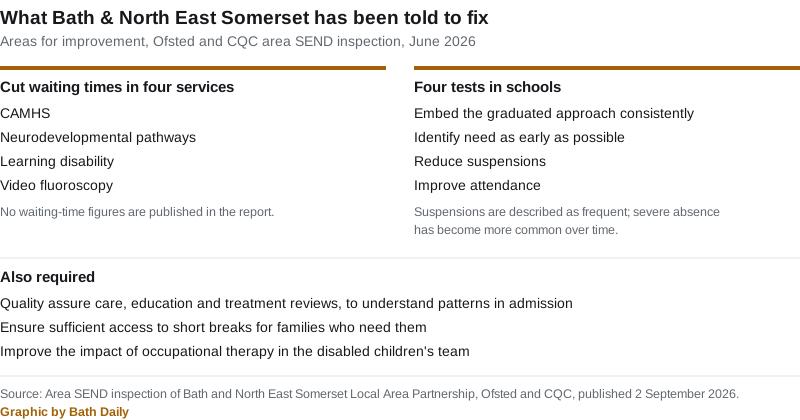
The recommendations are specific. The partnership is told to reduce waiting times for specialist assessment, diagnosis and support in four named services:
- child and adolescent mental health services (CAMHS)
- neurodevelopmental pathways
- learning disability
- video fluoroscopy
Leaders are also told to quality assure care, education and treatment reviews so they understand patterns in admission, to make sure there is enough access to short breaks, and to improve the impact of occupational therapy in the disabled children’s team.
On schools, the partnership must speed up its vision for what should be ordinarily available. Four tests are attached to that:
- consistent embedding of the graduated approach across schools
- the earliest possible identification of need
- a reduction in suspensions
- improved attendance
The findings behind those asks
Some of the detail in the report is harder reading than the council’s summary of it. Inspectors found that:
- suspensions of children with SEND are frequent, and severe absence from school “has become more common over time”
- some children are educated through a mix of part-time unregistered alternative provision as a stopgap when no suitable school place can be found, giving them a fragmented education
- some packages for children educated otherwise than at school are “shaped by what is available rather than what is most appropriate”, with some children attending several settings part time and receiving no other education
- too many children wait too long for CAMHS support, “leading to increasing need, with limited support in place”
- some parents said EHC plans and annual reviews do not reflect their views accurately, although waits for initial assessments and final plans are reducing
- practitioners in the 0 to 19 service do not routinely contribute to EHC plans, and occupational therapy advice is “not always easily identifiable” in them
- short breaks, including overnight breaks, do not meet the number of requests, and “where this breaks down, families can find themselves in crisis”
- waits for home adaptations remain too long, which can leave families lifting and moving children without the right equipment
- children and young people “do not know enough about the activities they can access through the local offer”, with a reliance on parents finding and paying for them
Two of the 2019 findings have come back
The 2019 inspection was a letter rather than a graded report. It did not require a written statement of action. It listed three areas for improvement (2019 joint local area SEND inspection letter):
- the attainment gap for pupils with SEND
- fixed-term exclusions above the national rate
- annual reviews of EHC plans not used as an effective check on progress
Seven years on, two of those three are in the report again in a different form. Suspensions are described as frequent, and EHC plans and annual reviews are said not to reflect families’ views consistently.
What the council and the NHS say
The council’s own announcement leads on progress, saying the report “recognises strong partnership working, effective early help services and significant work to improve outcomes” (council statement, 2 September).
Councillor Paul May, cabinet member for children’s services, said the partnership is “updating its strategic improvement plan in response to the report’s recommendations”. Lucy Baker, place director at the Bath and North East Somerset, Swindon and Wiltshire Integrated Care Board, called the report “a clear roadmap for further action”. Rachel Hale, strategic director and chief executive of the B&NES Parent Carer Forum, said she hoped it would reassure parents “that their voices are being heard”.
What it means for you
If you are waiting for an assessment, the four services named in the report are the ones the partnership has been told to fix: CAMHS, neurodevelopmental pathways, learning disability and video fluoroscopy. The report does not publish waiting times for any of them, so there is no benchmark yet against which to measure whether they improve.
If your child has an EHC plan, the report says waits for initial assessments and final plans are coming down. It also says plans and annual reviews do not consistently reflect parents’ views, and that the health and social care advice inside them is variable. That is a reason to check what the plan says about the amount and type of support, not only that a plan exists.
If you need short breaks or a home adaptation, these are the two areas where the report is most direct that supply does not meet demand.
Where the promised improvement plan will appear. Ofsted and the CQC have asked the partnership to update and publish its strategic plan based on the report’s recommendations. The council’s existing plan is published at bathnes.gov.uk/our-plan-send. There is no published date for the updated version.
The partnership is Bath and North East Somerset Council together with the NHS integrated care board cluster covering Bath and North East Somerset, Swindon, Wiltshire, Dorset and Somerset. The council’s director of children’s services is Jean Kelly, appointed in August 2025. The inspection was carried out at the request of the Secretary of State for Education, under section 20(1)(a) of the Children Act 2004. Lydia Pride of Ofsted led it, with Harriet Doran as the CQC lead inspector.
Sources: Area SEND inspection of Bath and North East Somerset Local Area Partnership, Ofsted and CQC, published 2 September 2026; Ofsted’s report page for Bath and North East Somerset Council; area SEND inspection framework and handbook; joint local area SEND inspection letter, 2 May 2019; B&NES council statement, 2 September 2026.
More local information: Bath planning news, bin collection days, council tax bands.
Have your say