
Bath is on Wessex Water, restricted since 18 August. Keynsham, Radstock and the Chew Valley are on Bristol Water, restricted from 27 August. Both fine £1,000.
Two separate hosepipe bans now cover Bath and North East Somerset, and which one applies to your home depends on who sends your water bill.
Wessex Water restricted hosepipes across its supply area from 00:01 on 18 August. Bristol Water followed from 00:01 on 27 August. Both restrictions run until further notice. Breaking either one is a criminal offence carrying a fine of up to £1,000.
The district is split between the two companies. That split does not follow council or postcode boundaries, so a Bath postal address is not a guarantee of being on Wessex Water.
Which ban covers you
We put real local addresses through Wessex Water’s own postcode checker on 31 August. It names the supplier for any address in the area. The results:
- four Bath addresses in BA1 and BA2 returned Wessex Water, with the checker adding “there is a hosepipe ban in your area”
- BS31 addresses, covering Keynsham and Saltford about six miles west of Bath, returned Bristol Water
- BA3 addresses, covering Radstock and Midsomer Norton about ten miles south west, returned Bristol Water
- BS39 and BS40 addresses in the Chew Valley and around Paulton, about ten miles west, returned Bristol Water
- one outlying BA2 postcode with a Bath postal address also returned Bristol Water
That last result is the reason to check rather than assume. Put your own postcode into either company’s checker before you reach for a hose.
What is banned
The prohibited uses are the same under both bans, because both are made under sections 76 to 76C of the Water Industry Act 1991 and the Water Use (Temporary Bans) Order 2010. Sprinklers, dripper hoses and automatic irrigation systems all count as hosepipes. You must not use one for:
- watering a garden, lawn, allotment, verge or any other green space
- cleaning a private motor vehicle
- watering plants on domestic or other non-commercial premises
- cleaning a private leisure boat
- filling or maintaining a domestic swimming pool or paddling pool
- drawing water for domestic recreational use, including water slides
- filling or maintaining a domestic pond
- filling or maintaining an ornamental fountain
- cleaning the walls or windows of domestic premises
- cleaning paths or patios
- cleaning other artificial outdoor surfaces
A watering can or bucket filled from the mains is still allowed for most of those jobs. So is rainwater from a butt, grey water or a private borehole. Drinking, cooking, washing and flushing are unaffected. Wessex Water’s statutory notice adds one catch: swimming pools, paddling pools and ornamental fountains cannot be filled from the mains by bucket either.
Why the two bans happened for different reasons
Wessex Water blamed demand and weather. It cites “record breaking heatwaves and lower-than-average rainfall” and record levels of demand on its network. The company says it has been 50 years since water restrictions were last needed in its region.
Bristol Water’s reasoning is different, and it is not about its own reservoirs. Its 26 August announcement says the ban protects water resources in the River Severn, following a drought order by the Environment Agency. In dry weather the company takes more than half its water from rivers, including the Severn via the Gloucester and Sharpness Canal.
Its reservoirs are actually in better shape than they were last summer. Bristol Water’s own storage figures for 24 August put total storage at 55 per cent, against 41 per cent on the same date in 2025.
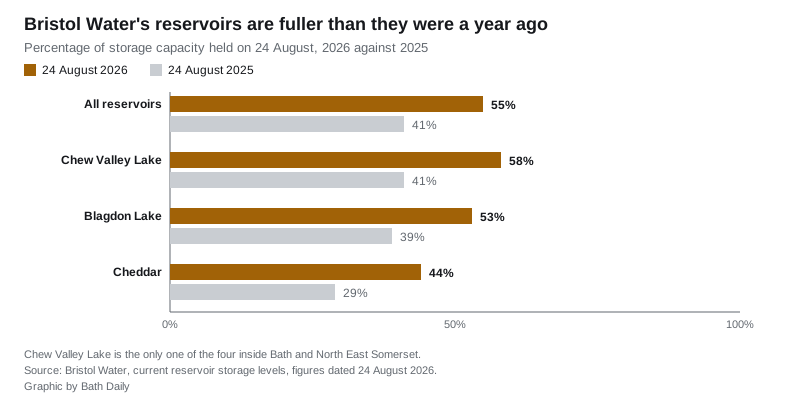
Chew Valley Lake, the only one of the four reservoirs inside this district, was at 58 per cent, up from 41 per cent a year earlier. Blagdon Lake was at 53 per cent against 39 per cent. Cheddar was the weakest at 44 per cent, still well up on 29 per cent in 2025.
One warning if you go looking for this yourself. Bristol Water’s drought page still said “there are currently no restrictions planned across our region” when we checked it on 31 August, four days after the ban began. The hosepipe ban page and the statutory notice are the pages to trust.
The exemptions are not identical
This is where the two companies genuinely differ, so check your own supplier’s list rather than a neighbour’s.
Bristol Water’s full notice and its exceptions page grant an automatic exception to:
- Blue Badge holders with severe mobility problems, for watering a garden or plants
- customers on its Priority Services Register who cannot reasonably adapt because of a health condition or disability
- customers on its WaterSure Plus tariff in the same position
- businesses using a hosepipe in their day to day trade, such as hand car washing, window cleaning and graffiti removal
- approved drip or trickle irrigation fitted with a pressure reducing valve and a timer
Wessex Water has no blanket Blue Badge exception. Its exemptions page lists medical and mobility conditions instead, and points customers to its Priority Services Register. It also exempts:
- turf laid within the last 28 days
- trees, hedges and saplings planted within the last three years
- sports pitches and surfaces that would otherwise become dangerously hard
- commercial food crops, and home or allotment food crops where a watering can is not feasible
- drip or trickle irrigation with a time and pressure reducing valve
Both companies allow hosepipe use for animal welfare and for health and safety.
What it means for you
- Check your supplier first. The postcode checker on Wessex Water’s hosepipe ban page names your supplier either way. If it says Bristol Water, the rules that apply to you are on Bristol Water’s page. The two bans started nine days apart and their exemptions differ.
- A watering can is still fine for the garden, and a bucket and sponge for the car. Neither ban touches indoor water use.
- If you need an exemption, apply to your own company. Wessex Water takes representations by email at hosepipe.ban@wessexwater.co.uk. Bristol Water’s formal representation window closed at 07:00 on 27 August, but it still lists customer services on 0345 702 3797 for discretionary requests.
- Neither company has given an end date. Both notices say the restrictions continue until further notice, and Bristol Water says it cannot give a timeframe.
- Council flowerbeds are already off the hose. In its newsletter of 20 August, Bath and North East Somerset Council said it had stopped using hosepipes on all flowerbeds and displays in its parks, and is prioritising watering newly planted trees.
Garden waste collections are set by the council, not the water companies, and the dates are on our Bath bin collection days page. For days out around the reservoir and the rest of the district, see things to do in Bath.
Have your say