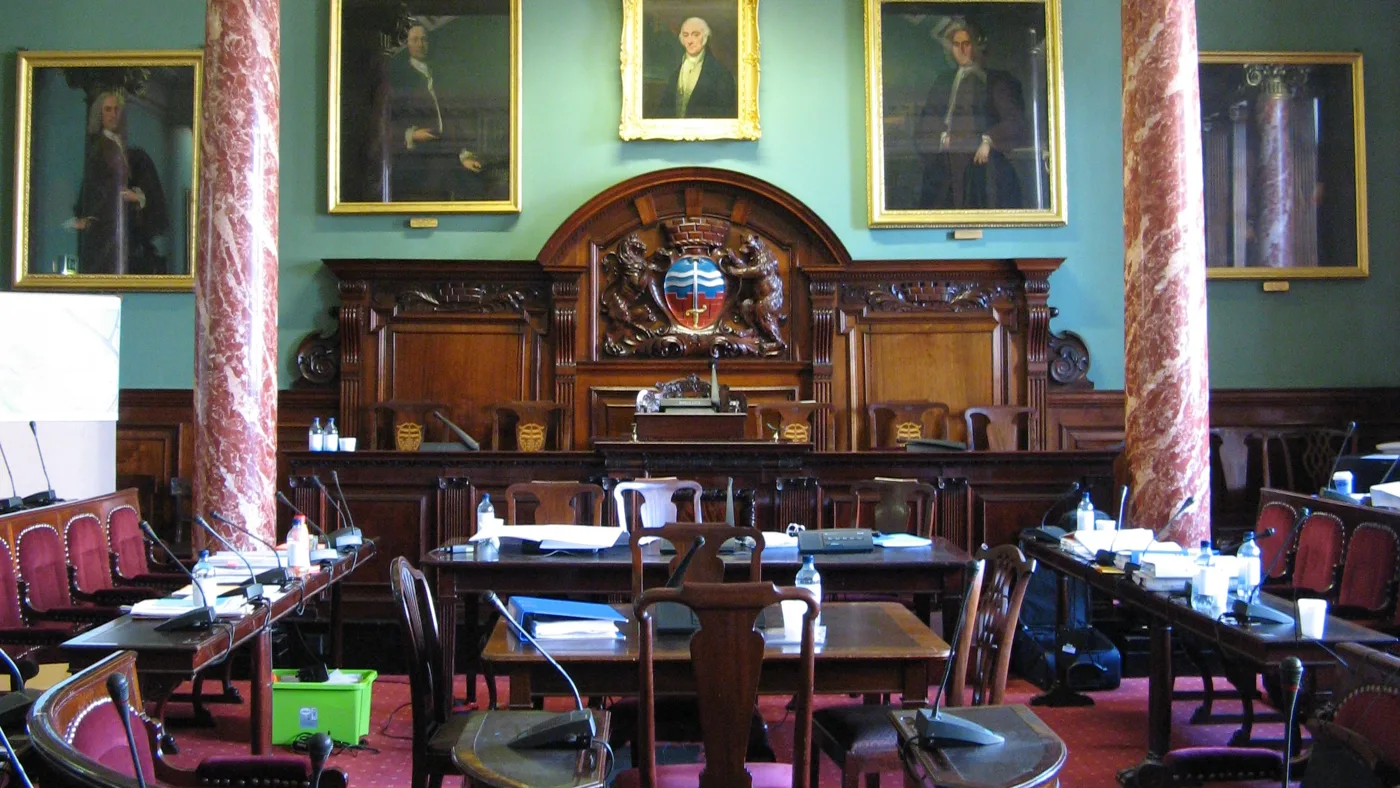

Cllr Bharat Pankhania told full council on 16 July he would resign. No vacancy notice has been published, and he was the only member absent on 17 September.
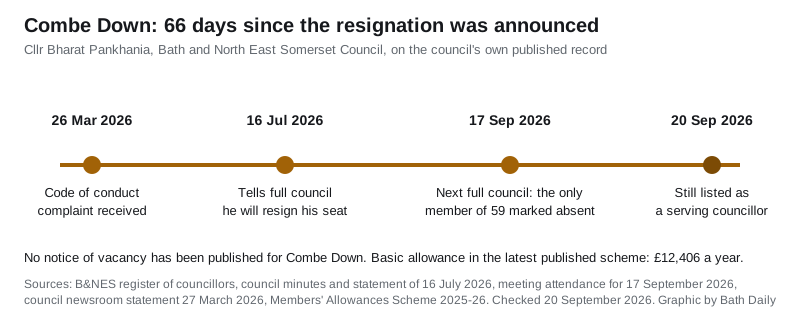
Sixty-six days after telling the council chamber that “the time has come for me to resign my seat”, the former Mayor of Bath is still a serving councillor on Bath and North East Somerset Council.
Cllr Bharat Pankhania appears on the council’s register of councillors today as the member for Combe Down, listed as Unaligned, with a term of office that runs from 8 May 2023 and no end date against it. He holds a seat on the Audit Committee. Combe Down is a two-member ward, and its other councillor is Cllr Onkar Saini.
No notice of a vacancy has been published for the ward.
What he actually said, and what the minutes record
Cllr Pankhania made a personal statement to full council on Thursday 16 July. The council publishes it in full, and it ends this way:
After careful reflection, I have decided that I will not be seeking a third term as a Councillor. I also believe that the time has come for me to resign my seat on the Council. This has not been an easy decision, but I need to give greater priority to my own health and wellbeing.
The statement names no date for that to happen. The printed minutes record it in one line, under questions and statements from councillors: “Councillor Bharat Pankhania made a personal statement about his time serving on the Council and as Mayor of Bath.” Nothing in the minutes treats it as a resignation.
That distinction is the whole story, because a resignation announced out loud is not a resignation in law. Section 84 of the Local Government Act 1972 says a councillor “may at any time resign his office by written notice delivered to the proper officer of the council”, and that the resignation “shall take effect upon the receipt of the notice”. At B&NES, that officer is the chief executive.
When it happens, the council says so in public. Its most recent notice of vacancy, for Widcombe & Lyncombe ward in September 2025, uses a fixed form of words: “NOTICE IS HEREBY GIVEN under Section 87(2) of the Local Government Act 1972 that following the resignation of Cllr Deborah Collins a casual vacancy has arisen for the office of Councillor”. It is signed by the chief executive, Will Godfrey.
There is no such notice for Combe Down. The council’s voting and elections index lists vacancy notices for Widcombe & Lyncombe and for Mendip ward, and no others. The address a Combe Down notice would sit at returns a “page not found”.
The record since 16 July
One full council meeting has been held since the statement, on Thursday 17 September. The council’s own attendance record for that meeting shows:
- 52 councillors present
- six apologies, from Cllrs Blackburn, Box, Dando, Johnson, Morgan and Chris Warren
- one councillor marked “Absent”: Cllr Pankhania
He was the only member of the 59 recorded that way. Cllr Saini, the other Combe Down member, was present.
At the July meeting itself, the council went the other way. Under minute 20 it unanimously agreed a revised political proportionality table, drawn up “following a change in political group membership”. That table counts “Unaligned (Cllr Pankhania)” as a group of one among the 59 seats and gives him one of the five voting places on the Audit Committee. The committee’s membership page still lists him. It next meets at 5.30pm on Wednesday 23 September.
Two dates that now matter
The first is 16 January 2027. Section 85 of the same Act says a member who “fails throughout a period of six consecutive months from the date of his last attendance to attend any meeting of the authority” ceases to be a member, unless the council approved a reason for it before that period ran out. His last recorded attendance is 16 July 2026, so on the published record the six months expire in mid-January. Attending a committee counts, so Wednesday’s Audit Committee would reset the clock.
The second is early November. The council says its next election is in May 2027, held every four years across all 33 wards and 59 seats, and that “if a councillor resigns, dies or becomes disqualified during their term of office, a by-election is held to fill the vacancy in their ward”. Section 89(3) qualifies that: where a casual vacancy “occurs within six months before the day on which the councillor whose office is vacant would regularly have retired”, no by-election is held, and the seat is filled at the next ordinary election instead. Six months before a May 2027 poll falls in early November. A resignation delivered after that point would leave Combe Down with one councillor until next May, and no vote.
What it means for you
For Combe Down residents, the practical position is unchanged for now: two names, one of whom has said he intends to go. Ward casework, planning objections and the rest still go to either member, and Cllr Saini is the one attending meetings.
For everyone else in the district, the cost is small but real. The council’s most recently published members’ allowances scheme, covering 2025-26, sets a basic allowance of £12,406 a year, “paid to each Councillor” and “paid monthly”. Clause 7 lets a councillor give written notice to the solicitor to the council to forgo any part of it. The published record does not say whether that has happened here; the council publishes what each member was actually paid only after the financial year ends. Allowances come out of the same revenue budget that council tax pays into.
If a by-election does follow, it will not be quick. The council’s own notice explains that two local government electors must ask for one in writing, after which polling day is set within 35 working days of that request.
How this started
The council issued a statement on 27 March 2026. It reads in full: “All councillors are expected to abide by the code of conduct. The council received a complaint in regard Councillor Bharat Pankhania on the afternoon of Thursday March 26. Any complaints about a councillor will be investigated under the council’s standards procedure. There are no further comments at this time.”
The council has published nothing further about that complaint or its outcome. Cllr Pankhania addressed it himself in July: “I made a mistake, a momentary error and shared a social media message before realising its implied subtext. I am sorry I did that and I wish I hadn’t.” He also said he “regret[ted] the distraction this caused to the Council and to the Mayoralty” and had “stepped back as soon as I was asked”. The mayoralty has since passed on; the council’s newsletter of 17 September names Cllr Ruth Malloy as Mayor of Bath.
Bath Daily has taken every fact here from the council’s own published record, checked on Saturday 20 September. If a resignation is delivered and a vacancy notice is published, this page will be updated rather than replaced.
Frequently asked questions
Has Bharat Pankhania resigned as a councillor?
Not on the council’s published record. He told full council on 16 July 2026 that he believed “the time has come for me to resign my seat”, but the council still lists him as the member for Combe Down, and no notice of vacancy has been published. A resignation takes effect only when written notice reaches the council’s proper officer.
Who else represents Combe Down?
Cllr Onkar Saini. Combe Down is one of the B&NES wards with two councillors.
Would there be a by-election?
Only if the vacancy arises in time. The council says a by-election follows a resignation, but section 89(3) of the Local Government Act 1972 removes that duty once a vacancy falls within six months of the day the councillor would regularly have retired. With the next full election due in May 2027, that cut-off lands in early November 2026.
Is he still being paid?
The latest published allowances scheme, for 2025-26, sets the basic allowance at £12,406 a year, paid monthly to each councillor, and lets any councillor give written notice to forgo part of it. The council publishes the amounts each member actually received only after the financial year ends, so the current position is not on the public record.
Have your say