
B&NES has set air pollution targets: nitrogen dioxide at 20µg/m3 by 2030 and WHO levels by 2035. Its forecast still has 11 sites over the 2030 figure.
Bath and North East Somerset now has its own air pollution targets, set well below the legal limits. The council’s cabinet adopted a Clean Air Strategy and local targets on Thursday 10 September (decision notice, B&NES).
Councillors can call the decision in for review until 18 September. If nobody does, it takes effect on 19 September.
The targets
The targets are annual averages, measured in micrograms per cubic metre (µg/m3). They sit alongside the UK’s legal objectives, which stay as they are:
| Pollutant | UK objective | B&NES by 2030 | B&NES by 2035 |
|---|---|---|---|
| Nitrogen dioxide (NO2) | 40 | 20 | 10 |
| Coarse particles (PM10) | 40 | 20 | 15 |
| Fine particles (PM2.5) | 20, falling to 10 by 2040 | 10 | 5 |
The 2030 figures match the limits the EU is to reach by 2030. The 2035 figures match the World Health Organisation’s guideline values (cabinet report, Table 3).
Where the district stands now
Every monitoring site in the district met the UK objectives in 2025, the council’s latest annual report says (Annual Status Report, B&NES). The detail is more mixed:
- nitrogen dioxide was measured at 151 locations, and all were below 40
- across the network it rose by 2% on average on 2024, with about two thirds of sites up. The council says 2024 may have been an unusually low year
- PM10 at Windsor Bridge and the A4 roadside monitor in Bath rose by an average of 20%
- Windsor Bridge had 18 days over the 24-hour PM10 limit, against 35 allowed. The council puts that down to construction dust nearby
Three Air Quality Management Areas remain, where the nitrogen dioxide limit was breached in the past. One covers Bath. The others are Farrington Gurney and Temple Cloud, villages on the A37 about ten miles south-west of the city. The areas in Keynsham and Saltford were revoked in 2024.
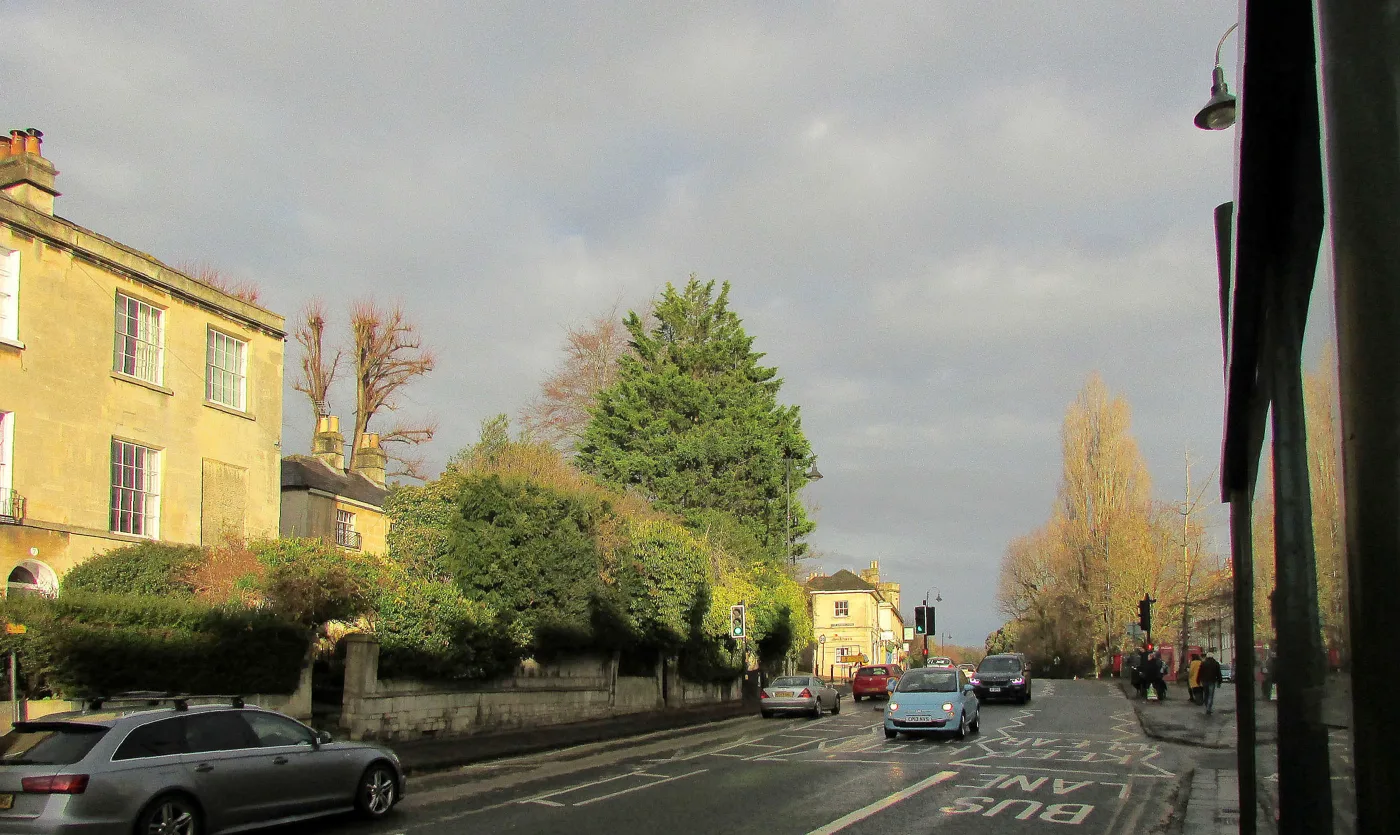
Gay Street in Bath already beats two of the 2030 targets. Its monitor is linked to the traffic lights in Queen Square: a high 15-minute reading changes the light sequence to discourage traffic. In 2025 it averaged 18 for nitrogen dioxide, 13 for PM10 and 9 for PM2.5.
The gap to close
The council’s own forecast says 11 monitoring sites would still be above 20 for nitrogen dioxide in 2030. Most would be no more than 2 over by 2031, as older vehicles leave the roads. The strategy calls the target “somewhat stretching” but “thought to be achievable” (Clean Air Strategy).
Diesel is the main problem for nitrogen dioxide. On four roads the council modelled, including Wells Road in Bath and the A37 at Farrington Gurney, diesel cars were the biggest source, with diesel vans close behind.
Particles are harder. Much of the district’s PM drifts in from elsewhere in the UK and Europe. In 2024, roadside sources contributed just 2.8µg/m3 of PM10 and 0.38µg/m3 of PM2.5. The strategy says measures aimed only at traffic “would be ineffective”. It calls the 2035 PM2.5 target “a lot more ambitious”.
What the council has committed to
The strategy sets five aims:
- keep reducing the effect of pollution on health
- understand how air quality and inequality are linked across the district
- raise public understanding of local air quality
- build a more accurate local picture
- set up a steering group to write an action plan with measurable actions
Progress will be reported each year in the annual air quality report. The council also wants to monitor more particulate matter, but only if it finds the money. It cannot say what the equipment will cost until it has run a tender.
The report is plain about the limits. Adopting the strategy “does not, in itself, commit the Council to unfunded expenditure or any specific measures”. The targets are local policy, and “do not create additional statutory objectives” (cabinet report, paras 3.14 and 9.3).
A public consultation ran from 12 May to 23 June. It drew 207 responses: about 60% backed the targets and the strategy, 23% did not and 15% were neutral.
Councillor Sarah Warren, the deputy leader, said the strategy “sets out our ambition to go further, protecting our most vulnerable residents, improving public health and ensuring everyone can benefit from cleaner air now and in the future” (B&NES newsroom).
What it means for you
Nothing changes on the street on 19 September. No new charge or restriction comes with the strategy. The Clean Air Zone in Bath carries on as before.
What you get is a yardstick. Each year’s report will now measure the district against 20 by 2030, not just the legal 40. You can check the readings from the tube nearest you on the council’s nitrogen dioxide monitoring map, which shows the last five years.
Whether the targets are met depends on money the council has not yet found, and on a steering group and action plan that do not exist yet. Those are the things to watch.
Sources
- Decision details: Clean Air Strategy and Local Air Quality Targets (B&NES Cabinet, 10 September 2026) for the adoption, the call-in deadline of 18 September and the effective date of 19 September.
- Cabinet report E3732, Clean Air Strategy and Local Air Quality Targets (B&NES) for the targets, the UK, EU and WHO comparison, the management areas, the funding position and the consultation results.
- Appendix 1, Clean Air Strategy (B&NES) for the aims, the 2030 forecast, the diesel modelling and the particulate figures.
- LAQM Annual Status Report, published 2026 (B&NES) for the 2025 monitoring results and the Gay Street readings.
- Council proposes ambitious clean air strategy to protect public health (B&NES newsroom, 7 September 2026) for the councillor’s quote.
Have your say