

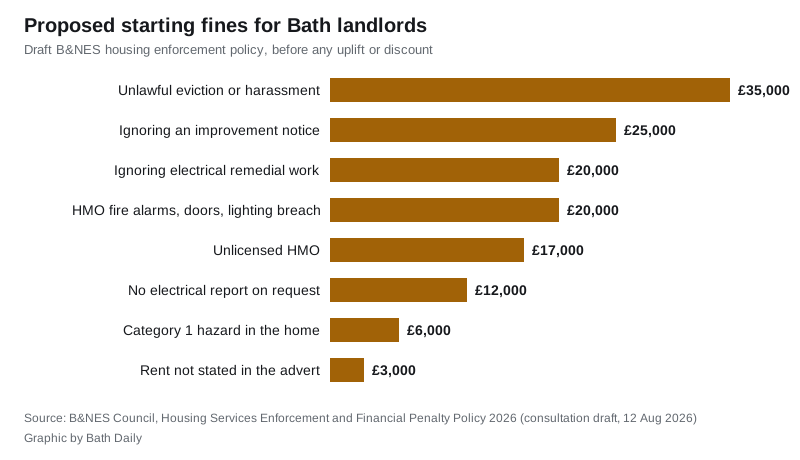
B&NES Council wants a £20,000 starting fine for landlords who ignore an electrical fault or run an HMO without working fire doors, uplifted by up to 50 per cent for repeat offenders. Consultation closes 23 September.
Landlords in Bath and North East Somerset who ignore an order to fix dangerous wiring, or let a shared house without working fire alarms and fire doors, would face a starting fine of £20,000 under a new penalty scale the council put out to consultation on 12 August. Residents, tenants and landlords have until 5pm on Wednesday 23 September to say what they think.
The figures come from the draft Housing Services Enforcement and Financial Penalty Policy 2026, a 36-page document that sets out how Bath & North East Somerset Council will use the civil-penalty powers it gained under the Renters’ Rights Act 2025 instead of taking every case to court. It replaces the 2022 policy and, once adopted, applies to breaches committed on or after 1 May 2026.
The council’s consultation page is unusually candid about what it wants views on: not just the tone of the policy, but the specific pound figures where it has local discretion, and the size of the uplifts and discounts it would apply on top.
The numbers on the table
Most starting penalties are set nationally by government guidance and the council is simply adopting them. The draft lists a £35,000 starting point for unlawful eviction or harassment, £25,000 for failing to comply with an improvement notice, £17,000 for running a licensable HMO without a licence, and £6,000 for a home with a Category 1 hazard, the most serious kind under the housing health and safety rating system.
Two tables are Bath’s own choice, and those are the ones the consultation asks about directly.
Electrical safety. For breaches of the 2020 electrical safety regulations, which require a satisfactory electrical report at least every five years, the draft proposes:
- Failing to meet the electrical safety standards: £12,000
- Failing to carry out remedial work an electrician has flagged: £20,000
- Failing to produce the electrical report when asked: £12,000
- Any other breach of the regulations: £7,000
Licence conditions on shared houses. For landlords who hold an HMO licence but break its conditions:
- Breaching the fire standards for alarms, fire doors and emergency lighting: £20,000
- Over-occupying the house or providing too few kitchens and bathrooms for the number living there: £20,000
- Failing to produce safety certificates on demand: £12,000
- Failing to give tenants required information: £3,000
- Any other condition, including those on anti-social behaviour and waste: £7,000
The statutory maximum for these categories is £40,000; for the lighter breaches created by the Renters’ Rights Act, such as advertising a home without stating the rent (£3,000 starting point) or accepting a bid above the advertised rent (£4,000), the ceiling is £7,000.
How a fine goes up or down
The starting figure is only step one. The draft then allows the council to add up to 50 per cent for aggravating factors, capped at 50 per cent however many apply. The list includes a previous penalty, caution or warning letter, a breach that has run for more than six months, failing to give “a substantive response to a letter alleging an offence”, failing to attend an interview, pressuring tenants not to cooperate, and actual harm to an occupant.
It can then take off up to 50 per cent for mitigating factors: repairs completed within 28 days, a high level of cooperation, admitting responsibility before a notice of intent is issued, self-reporting, and a good compliance history. Hiring a letting agent does not count as mitigation on its own; the draft says “reliance on an agent’s actions or omissions, will not by itself constitute diminished culpability”.
Finally there is a 20 per cent adjustment for who the landlord is. The uplift applies to anyone with six or more properties, three or more HMOs, a corporate landlord or director, or a professional letting agent. The 20 per cent discount applies only where every one of these is true: the landlord has ever owned or managed two properties or fewer, one HMO or fewer, and has “very limited experience” of letting.
Worked through, a portfolio landlord who has already had a warning letter and then ignores an electrician’s remedial list could face £20,000, plus £10,000 for aggravation, plus £4,000 for scale: £34,000 for one property. A first-time landlord with a single flat who fixes the fault inside 28 days and cooperates could see the same £20,000 starting point fall to £6,000.
Why the council is doing this now
The council’s announcement ties the rewrite to the Renters’ Rights Act 2025, which the draft says places a duty on the council under section 107 to enforce the new landlord legislation and, under section 110, to report to the Secretary of State on how it does so. The Act also lets councils issue penalties for a wider range of breaches without prosecuting, and extends rent repayment orders.
Councillor Matt McCabe, cabinet member for built environment, housing and sustainable development, said most local landlords “act responsibly and provide good quality accommodation”, and that the policy is meant to make enforcement “fair, transparent and proportionate”. The council says it “will continue to help landlords understand and follow the rules”.
The sector this touches is large here. At the 2021 census, 15,309 of the district’s 79,250 households rented privately, just over 19 per cent, and 13,758 of those rented from a private landlord or letting agency.
For discrimination and rental-bidding breaches the council would use the civil standard of proof, the balance of probabilities. For everything else where prosecution is the alternative, it keeps the criminal standard, beyond reasonable doubt.
What it means for you
If you rent. Nothing changes yet; this is a draft. Once adopted, the policy sets out how the council will respond if you report a serious hazard, an illegal eviction attempt, or a landlord who will not produce a gas or electrical certificate. The consultation says the council particularly wants to hear from tenants. Bath’s additional HMO licensing scheme ended on 31 December 2023 and has not been replaced, so at present only larger shared houses (five or more people from more than one household, sharing facilities) need a licence; the licence-condition fines above apply to those, while the electrical and hazard penalties apply to every private let.
If you let property. The two locally set tables are the ones you can still influence, and the consultation form asks specifically whether the starting figures are right. Note that the draft applies to breaches from 1 May 2026, so conduct earlier this year is covered by the 2022 policy. If you have already missed a five-year electrical inspection date, the mitigation list rewards fixing it within 28 days and telling the council before it finds out.
How to respond. The online form is on the consultation page; read the draft PDF first, since the survey assumes you have. If you need another format or help completing it, the council gives 01225 396 444 and housing@bathnes.gov.uk, and says staff at council-run libraries and information centres can help in person. It closes at 5pm on Wednesday 23 September 2026.
What happens next. The council says it will consider the responses, amend the draft, and then put it to the cabinet member for built environment, housing and sustainable development for a decision on adoption. There is no committee vote; it is a single-member decision, which means the consultation is the main point at which the numbers can move.
Separately from licensing, converting a family home into a small HMO in Bath needs planning permission because of the city’s Article 4 direction; the Bath planning news page tracks those decisions, and the Bath house prices page has the latest Land Registry figures for anyone weighing renting against buying.
Have your say